
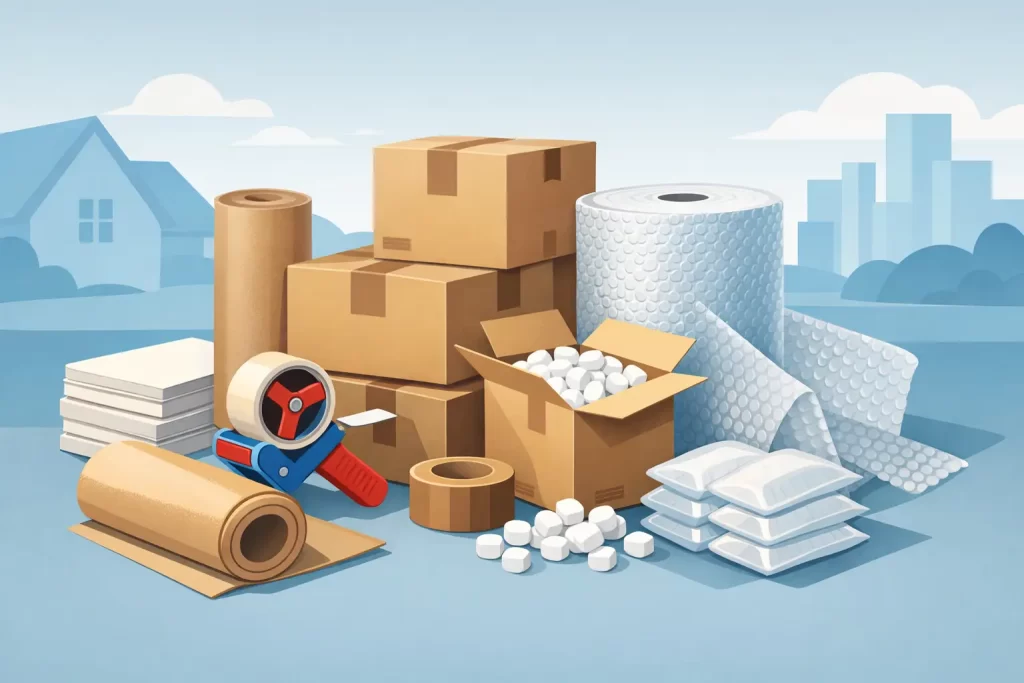
A move usually goes wrong before the ute even arrives. It happens when books go into weak boxes, glasses are wrapped in old clothes that shift in transit, or tape gives way halfway down the driveway. Choosing the best packing materials for moving is what keeps a straightforward job from turning into a frustrating one.
The right materials do two things at once. They protect your belongings from knocks, pressure and movement, and they make the whole move faster to pack, load and unpack. If you are moving house, relocating a unit, or shifting a small office, good materials are not a luxury. They save time, reduce breakages and take a lot of stress out of the day.
What are the best packing materials for moving?
The best packing materials for moving are sturdy cardboard boxes, packing paper, bubble wrap, strong tape, stretch wrap, labels and purpose-made cartons for fragile or awkward items. That said, the best choice depends on what you are moving. A kitchen packed properly needs different protection from a wardrobe, a desktop computer or a framed mirror.
This is where people often overspend or cut corners. Buying too many specialty products can add up quickly, but using whatever is lying around can cost more if items arrive damaged. The practical approach is to match the material to the item and use stronger protection where it counts.
Strong moving boxes come first
Boxes do most of the heavy lifting in any move. If the box fails, whatever is inside is at risk, no matter how much wrap you used. Good moving boxes should be clean, dry, rigid and suited to the weight of the contents.
Small boxes are better for heavy items like books, files, tools and canned goods. Large boxes work better for lighter, bulkier things such as linen, cushions, clothing and toys. One of the most common packing mistakes is loading a large box with heavy items until it becomes too hard to carry and more likely to split.
Double-walled boxes are worth using for anything fragile, valuable or heavy. They cost more than lighter cartons, but they hold their shape better during lifting, stacking and transport. If you are moving over a longer distance, that extra strength matters even more.
Packing paper is more useful than most people expect
Packing paper is one of the most reliable materials you can buy. It is simple, affordable and works across nearly every room in the house. You can wrap plates, bowls, mugs, ornaments and glassware, and you can also use it to fill gaps in boxes so items do not shift around.
It is usually a better option than newspaper. Newspaper can leave ink marks on ceramics, fabrics and lighter-coloured surfaces, and it does not always cushion items well enough on its own. Clean packing paper avoids that mess and gives a more consistent layer of protection.
For kitchens in particular, paper earns its place. Wrapping each breakable item and then cushioning the box with crumpled paper creates a stable pack that handles bumps much better than a quick stack-and-go job.
Bubble wrap has its place, but do not use it for everything
Bubble wrap is one of the best-known packing materials, and for good reason. It gives excellent shock protection for delicate items like glassware, framed art, electronics and decorative pieces. It is especially useful when an item has corners, edges or surfaces that can chip or crack easily.
Still, bubble wrap is not the answer for every box. It can become expensive if you use it across an entire move, and it takes up space. For everyday household items, packing paper often does the job just as well. Bubble wrap is best saved for high-risk pieces where impact protection matters most.
When you do use it, wrap firmly without overdoing it. Too much wrap can make boxes awkward and waste space, while too little leaves the item exposed. The goal is a snug layer that absorbs movement, not a bulky parcel that barely fits in the carton.
Best packing materials for moving fragile items
Fragile items need a bit more planning. It is not just about wrapping the object. It is also about choosing the right carton, filling empty space and keeping weight balanced.
Glasses and stemware should be wrapped individually and packed upright where possible. Plates are often safer packed vertically with paper between each one rather than stacked flat in a tall pile. Lamps, vases and decorative pieces should be boxed with enough fill around them that nothing rattles when the carton is gently shaken.
For mirrors, artwork and televisions, purpose-made picture boxes or TV cartons are the safest option. These are designed to support flat, fragile surfaces that standard boxes do not protect well. If you are moving expensive electronics or sentimental artwork, this is not the place to improvise.
Tape matters more than people think
A cheap roll of tape can undo a lot of careful packing. Moving boxes need strong packing tape that sticks well, holds weight and stays secure during loading and transport. Masking tape and old household tape are usually not enough.
Use tape to seal the bottom of every box properly before you pack it, then seal the top once full. Heavy cartons may need reinforcing along the seams. It is a small step, but it prevents split bottoms and sudden spills when the box is lifted.
A tape dispenser also speeds things up. On a full packing day, little efficiencies matter, especially if you are trying to get everything done around work, kids or business operations.
Stretch wrap helps with furniture and loose parts
Stretch wrap is one of the handiest materials for furniture and oddly shaped items. It keeps drawers closed, secures loose cords, bundles smaller pieces together and protects surfaces from dust and light scuffs.
It works particularly well for items like bedside tables, office chairs and rolled rugs. You can also use it to hold blankets or pads in place around furniture. Just be careful with delicate finishes, especially timber and leather, because wrapping too tightly or for too long can trap moisture or mark the surface.
For furniture, protective moving blankets are often the better first layer, with stretch wrap used to keep them in place. That combination gives both cushioning and stability.
Do you need specialty boxes?
Sometimes yes, sometimes no. Not every move needs wardrobe cartons, wine boxes or book cartons in large numbers. But for some households and businesses, specialty boxes save a lot of hassle.
Wardrobe boxes are useful if you want to move hanging clothes without taking everything off the hanger. They are not essential for everyone, but they can speed up packing and unpacking, especially for family homes or office moves where presentation and convenience matter.
Port-a-robe style cartons, archive boxes for files, and reinforced cartons for computers or monitors can also make sense if you are moving a home office or a workplace. In a business move, the cost of proper materials is usually minor compared with the cost of damage or downtime.
Labels are not optional
Labels are one of the cheapest and most overlooked packing tools. A box marked kitchen is better than an unmarked box. A box marked kitchen – glasses – fragile – open first is much better again.
Clear labelling helps on both ends of the move. It lets movers place boxes in the right room quickly, and it saves you hunting through five cartons just to find the kettle or power board. If you are moving with children, managing an office setup, or arriving late in the day, that kind of organisation makes a real difference.
You do not need anything fancy. A thick marker and a simple system are enough, as long as you use them consistently.
How to choose the right materials without overspending
The smartest packing plan is not about buying the most supplies. It is about buying the right mix. Use strong standard boxes for most items, packing paper for everyday breakables, bubble wrap for high-value fragile pieces, and specialty cartons only where they genuinely add protection or save time.
If you are handling a local move around places like Nowra or Wollongong, you may be tempted to go lighter because the trip is shorter. Sometimes that works, but only if the packing is still sound. Most damage happens during packing, carrying and loading, not just on the road.
If you want the move to run smoothly, the materials should support the process rather than slow it down. Boxes should stack properly. Fragile items should be clearly packed and labelled. Furniture should be protected before it goes near the ute. That is what makes a move feel under control.
For households and businesses that want less guesswork, professional packing support can be the better option. A team that packs every day knows where stronger materials are needed and where simpler options are enough. That balance keeps costs sensible while giving your belongings the protection they need.
Good packing materials do not just protect your things. They protect your time, your budget and your peace of mind on a day that already has enough moving parts.