
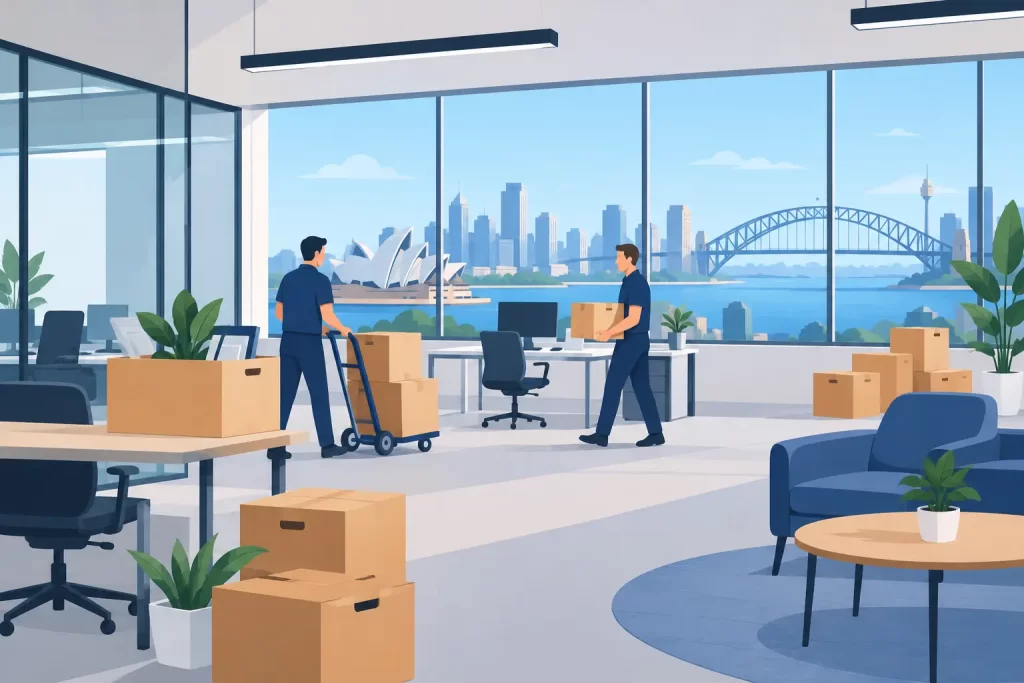
The latest office relocation trends Australia businesses are acting on are not about chasing a fashionable postcode. They are about making every square metre work harder, giving staff a reason to come together, and moving without putting customer service or day-to-day work on hold. For office managers, that makes the relocation itself just as important as the new address.
A commercial move can quickly become costly when desks are not labelled, IT equipment is left until the last minute, or staff arrive on Monday without a working place to sit. The businesses getting the best result are planning their move around operations, not simply around a truck booking.
Office relocation trends Australia businesses are following
Smaller offices with better-purpose spaces
Many businesses are reducing their overall footprint while improving the quality and purpose of their workspace. Rather than paying for rows of permanently assigned desks that sit empty through the week, they are choosing a mix of shared workstations, bookable quiet areas, meeting rooms and collaboration zones.
This approach can lower rent and outgoings, but it is not automatically the right answer for every business. Teams that handle confidential calls, need specialised equipment or work primarily from the office may require more fixed desks and private rooms. The key is to look at how your people actually use the space before committing to a layout.
A smaller office can also make relocation simpler, provided surplus furniture is dealt with early. There is little value in paying to move old filing cabinets, damaged chairs and unused storage units only to discover there is no room for them at the new site.
Hybrid work is changing what gets moved
Hybrid work has changed office planning across Australia. With staff splitting time between home and the workplace, businesses are taking a closer look at what must remain in the office and what can be digitised, stored elsewhere or retired.
Paper records are often one of the biggest issues. A move is a practical opportunity to sort active files from outdated documents, arrange secure disposal where appropriate and pack essential records in a clear order. The same applies to old promotional materials, redundant computer equipment and cables that no one can identify.
This does not mean every office needs to become minimal. A well-equipped workplace can support culture, training and better collaboration. It simply means the furniture, equipment and storage being moved should earn its place in the new office.
Locations that suit staff as well as clients
Access is playing a bigger role in office location decisions. Businesses are weighing up parking, public transport, nearby services and travel times for staff alongside rent and client convenience. For regional teams, a location close to major roads can also make visits, deliveries and interstate travel easier to manage.
For businesses moving around Nowra, Wollongong or the wider Illawarra, practical access matters on moving day too. Building loading zones, lift bookings, narrow entries and parking restrictions can all affect timing and cost. A site may look ideal during an inspection but still create headaches if a removal truck cannot safely get close to the entrance.
More focus on staff experience
Office design is increasingly being used to encourage staff back into the workplace for the parts of work that benefit from being together. That may mean better meeting spaces, natural light, a proper kitchen area, comfortable breakout seating or quieter rooms for focused work.
The trend is not about adding expensive features for their own sake. It is about creating a workplace that feels useful. If employees travel in, the office should help them do work that is harder to do from home, whether that is meeting clients, training new staff or working through a complex project as a team.
A successful move protects business continuity
The biggest risk in an office relocation is lost working time. Phones go unanswered, systems are unavailable, a key document cannot be found, or staff spend half a day searching through unmarked cartons. A planned move reduces those risks.
Start by identifying what cannot be offline and for how long. This may include customer service phones, internet, payment systems, server access, reception equipment and staff laptops. Speak with your IT provider early, particularly if the new premises need cabling, security access, Wi-Fi installation or equipment testing before staff arrive.
Moving over a weekend can suit some businesses, while others are better served by a staged relocation. A staged move may keep one area operating while another is packed and transferred. It can take more coordination, but for a busy professional office, clinic or customer-facing team, the reduced disruption may be worth it.
The move plan should be clear, not complicated
Every staff member should know what they are responsible for before moving day. That includes clearing personal items, backing up files, labelling desk equipment and identifying anything that should not be packed. Managers should also nominate one person to make decisions on the day if questions come up about furniture placement, access or timing.
A simple labelling system saves time at both ends. Each carton and item should show the destination area, the staff member or department, and a short description of contents. Colour-coded labels can help, but plain, readable labels work just as well when they are used consistently.
Measure large furniture before the move. Reception counters, boardroom tables, compactus units and bulky cabinets can cause delays if they do not fit through doorways, lifts or stairwells. Some items may need dismantling and careful reassembly, while others may be better replaced rather than relocated.
Furniture and equipment need different handling
Office furniture removals involve more than lifting desks into a truck. Screens, monitors, printers, glass tabletops, ergonomic chairs and filing systems all need suitable preparation. Fragile equipment should be protected, and cables should be labelled before they are disconnected so workstations can be set up correctly at the new location.
For larger relocations, a detailed floor plan is worth preparing. It tells the removal team where desks, cabinets and meeting-room furniture belong, reducing the need to shift heavy items multiple times. It also allows the business to check that power points, data outlets and walkways will work with the proposed layout.
Professional packing support is particularly useful where there are breakable items, archives, IT equipment or staff who cannot spare the time to pack properly. It adds to the upfront cost, but can reduce damage, confusion and lost productivity. The right choice depends on the size of the office, the deadline and how much internal time the business can realistically commit.
Choosing a removal team for an office move
Price matters, but the cheapest quote is not always the lowest-cost move. A poorly organised relocation can lead to damaged furniture, extended downtime and staff frustration that costs far more than a well-planned service.
Ask how the team handles access restrictions, heavy furniture, packing, dismantling and placement at the new office. Confirm the scope of insurance, the expected crew size, vehicle requirements and whether the quote accounts for stairs, lifts or difficult loading conditions. Clear answers before booking are a good sign that the job has been properly understood.
Mr Muscle Removals helps businesses plan office moves with careful packing, furniture handling and practical scheduling, so the transition is managed from pickup through to unloading.
Make the new office ready before the first workday
A relocation is only finished when people can work comfortably and customers can reach the business. Before the first day, test internet and phones, check keys and access cards, confirm signage, stock kitchens and bathrooms, and make sure emergency procedures are understood. Walk through the space as a visitor would, from the front door to reception and meeting rooms.
The most useful office relocation trends are the ones that make work easier after the cartons are gone. Give the move enough planning time, keep staff informed and choose support that treats your equipment and schedule with care. That is how a new office starts feeling like a working business from day one.