
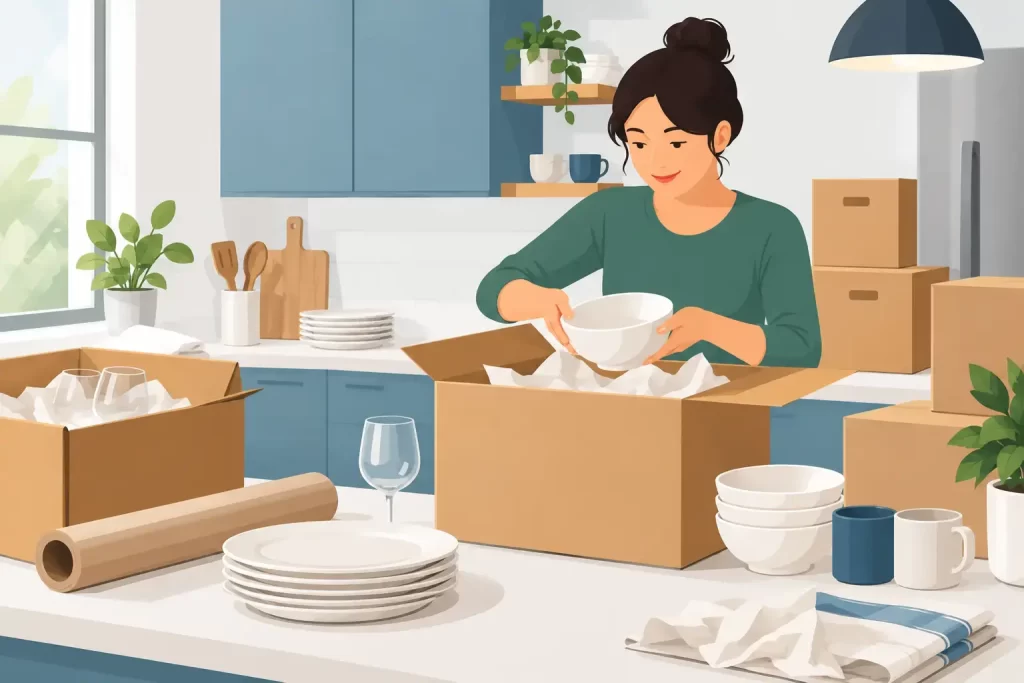
The kitchen is often the last room people want to face and the first room that creates trouble on moving day. Knowing how to pack a kitchen properly makes a real difference: there is less to carry, fewer fragile items at risk, and a much easier first night in your new home.
Unlike a bedroom, a kitchen contains heavy cookware, sharp utensils, food, appliances and plenty of breakable glassware. The key is not trying to do it all in one afternoon. Start early, work cupboard by cupboard, and pack each type of item in a way that protects it during loading, transport and unloading.
Start packing your kitchen earlier than you think
For most households, begin one to two weeks before the move. If you have a large family kitchen, entertaining gear or a pantry full of supplies, allow more time. Leaving it until the night before usually means rushed packing, overloaded cartons and items going into boxes without enough protection.
Before packing, set aside what you will need until moving day. Keep a small group of plates, mugs, cutlery, a saucepan, a frying pan, cleaning supplies and a kettle available. This becomes your temporary kitchen. Everything else can be packed away without interrupting daily meals.
It also helps to prepare one clearly marked essentials box for the first day at the new place. Include tea and coffee, long-life milk, snacks, a can opener, basic cutlery, dishwashing liquid, paper towel, a tea towel and a few plates or disposable cups. Keep this box with you rather than sending it deep into the moving truck.
Sort before you pack a kitchen
Moving is a good opportunity to be practical about what is actually worth taking. Empty every cupboard, drawer and pantry shelf in sections. Check expiry dates, put aside items you no longer use, and avoid packing damaged containers or appliances you have been meaning to replace.
Unopened pantry goods are generally fine to move, particularly tins, dry food, spices and sealed jars. Use smaller boxes for heavier items such as tinned food, cooking oils and glass jars. An oversized carton full of pantry supplies can become too heavy to lift safely and may split underneath.
Be cautious with opened liquids. Oils, sauces, vinegar and cleaning products can leak in transit, even when lids appear tight. Seal each bottle in a plastic bag, keep it upright and pack it in a sturdy box lined with packing paper or a towel. If a product is leaking, nearly empty or not worth the mess, throw it out before moving day.
For frozen food, chilled groceries and perishable items, plan ahead. Eat what you can in the week before the move and use an esky with ice bricks for anything that needs to travel a short distance. For a longer interstate move, it is often safer to give perishables away or replace them after arrival.
Use the right boxes and packing materials
Kitchen cartons need to be strong, clean and in good condition. Used boxes can be suitable if they are dry, sturdy and free from crushed corners, but avoid cartons that have been weakened by moisture. Heavy kitchen items quickly expose a weak base.
You will generally need packing paper, sturdy tape, a marker, small and medium cartons, and cushioning materials for gaps. Bubble wrap is useful for delicate pieces, but clean packing paper is often the more practical choice for wrapping plates, bowls and glasses. Towels, tea towels and linen can provide extra padding for sturdy cookware, although they should not replace proper protection for fine china or fragile glass.
Do not overfill a box just because there is space left. A carton should close flat, remain easy to lift and not bulge at the sides. If it feels too heavy for you to carry comfortably, it is too heavy for moving day.
Pack plates, bowls and glassware carefully
Breakables need individual wrapping and a stable base. Line the bottom of each carton with scrunched packing paper to create cushioning, then wrap items one at a time. Avoid stacking unwrapped dishes directly together, as vibration during transport can cause chips and cracks.
Plates are safest when packed on their edge rather than laid flat. Wrap each plate in paper, group a few similar-sized plates together, then place them vertically in the box with cushioning on both sides. Bowls can be nested with paper between each one, provided there is enough protection around the group.
For wine glasses, stemware and delicate mugs, wrap the handle or stem first before covering the entire item. Fill hollow spaces inside cups and glasses with paper so they do not collapse under pressure. Place heavier pieces at the bottom and lighter items on top, then fill every gap so nothing shifts when the carton is moved.
Write “FRAGILE” and “THIS WAY UP” on more than one side of the box. These labels help, but they are not a substitute for secure packing. A properly packed carton should not rattle when gently moved.
Keep boxes balanced
A useful approach is to combine a layer of heavy kitchenware with lighter items above it. For example, a few wrapped plates can go at the bottom of a medium carton, with plastic containers, tea towels or lighter bowls filling the remaining space. This keeps the box manageable without wasting room.
Avoid mixing fragile glassware with cast-iron pans, heavy appliances or loose utensils. Even with packing paper between them, these items can shift and cause damage.
Pack pots, pans, knives and utensils safely
Pots and pans are durable, but they still need sensible packing. Stack cookware by size with paper, tea towels or cardboard between pieces to prevent scratching. Put lids on their matching pots where possible, or wrap and pack them upright along the side of the carton.
Sharp knives need extra care. Wrap each knife securely in packing paper or a tea towel, then tape the wrapping closed so the blade cannot work free. Pack them flat in a clearly marked box rather than loose in a drawer organiser or bag. Never leave knives exposed for someone to find while unloading.
Group smaller utensils in bundles or place them in sealed containers. Cutlery trays can usually be wrapped as they are, as long as the contents are secured with paper or stretch wrap. This saves time at the other end and prevents forks, peelers and measuring spoons from spreading through the carton.
Handle appliances and cords properly
Small appliances such as toasters, blenders, air fryers, mixers and coffee machines should be cleaned and fully dried before packing. Empty crumbs, water reservoirs, loose grounds and food residue. Moisture trapped inside an appliance can create odours and damage during storage or transport.
If you still have the original box and internal packaging, use it. Otherwise, wrap the appliance in packing paper or bubble wrap and place it in a carton with padding underneath and around it. Remove detachable parts where possible, wrap them separately and place them in the same labelled box.
Wind cords neatly and secure them with tape or a tie, but do not tape directly onto polished surfaces where adhesive may leave residue. For more expensive appliances, take a quick photo before packing. It can help you remember how parts fit together after the move, and provides a record of their condition.
Label kitchen boxes for an easier unpack
Clear labels save time when the removal team unloads and when you begin setting up your new kitchen. Write the room first, then the contents and any handling instruction. “Kitchen – everyday plates”, “Kitchen – pantry, heavy” and “Kitchen – glassware, fragile” are far more useful than simply writing “kitchen”.
If you are moving into a multi-level home or apartment, add the destination room or floor. Let your removalists know which boxes need careful handling and which essentials should be unloaded where you can reach them first.
It is worth keeping a short inventory of valuable pieces, particularly specialty cookware, appliances, heirloom china or crystal. Photos taken before packing can provide reassurance and make it easier to check that everything has arrived.
When professional packing is the better option
Packing a kitchen yourself can work well when you have enough time, suitable materials and a manageable amount of belongings. But it is not always the best use of your week. Families with young children, people moving on a tight deadline, and households with extensive glassware or valuable items may prefer professional packing support.
A trained packing team can bring the correct materials, pack efficiently and prepare cartons for safe transport. This is particularly useful for local moves around Nowra, Wollongong and the Illawarra, where a well-organised move can reduce the pressure of coordinating keys, cleaners, work commitments and settlement times.
Mr Muscle Removals can assist with professional wrapping, packing and careful transport when you would rather leave the most time-consuming room to an experienced team. The right support depends on your budget and schedule, but getting help with fragile kitchen items alone can make moving day feel far more manageable.
Pack steadily, keep cartons sensible to lift, and protect the items you would be disappointed to replace. When the kettle is easy to find and the first box you open contains intact mugs and plates, your new home will start feeling settled much sooner.